

Fork Bushing Burnishing / Sizing Tool — Additional Head Sizes
Fork Bushing Burnishing / Sizing Tool — Additional Head Sizes
Fits every RMS handle ever made · All stanchion diameters available · All three +sizes available
Your handle already works. You just need the right head.
Every RMS burnishing head fits every RMS handle ever made — no compatibility questions, no version mismatches. Pick your stanchion diameter, pick your +size, and you're covered.
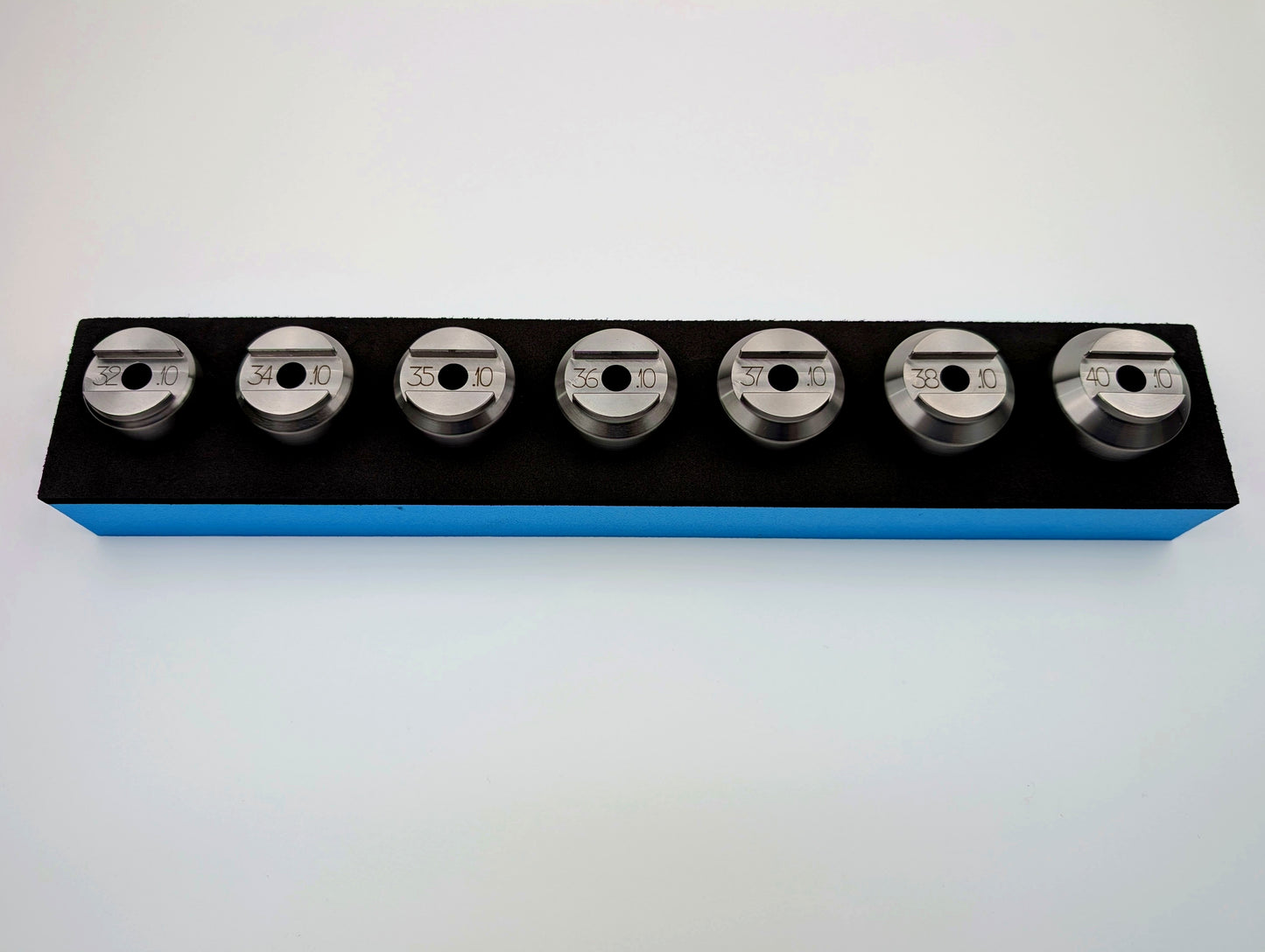
Adding a new fork to your quiver? Get the head for that stanchion diameter. Want to run a second +size pass on forks you're already servicing? Add the next +size up. Shops adding full coverage for a new +size across all fork sizes can order the 7-head bundle and cover every diameter in one go.
Heads only — handle not included.
Don't have the handle yet? Start with the Starter Kit →
Outfitting a shop? See the Full Set →
Want foam storage? Shop foam storage tray sets →
Couldn't load pickup availability
No tariffs for USA, all duties and import fees included for USA and EU — only local taxes may apply at checkout
What's included
What's included
• Burnishing head(s) — your selected diameter and +size
• Compatible with all RMS handles ever made
• Handle not included — need one? See the Starter Kit
Which +size is right for me?
Which +size is right for me?
If the fork generally feels okay but not great and doesn't degrade quickly after a service, +.07mm is likely sufficient. If the fork feels noticeably sticky or harsh, or degrades within the first ride after a service, start with +.10mm. If stiction remains after burnishing with +.10mm, move to +.13mm.

Your Setup Isn't the Problem. Your Bushings Are.
Most riders chasing suspension performance focus on the obvious: air pressure, tokens, rebound, compression. These adjustments can't fix a problem that's upstream of all of them.
Fork bushings conform to out of round seats and often leave the factory tight. When they're out-of-round or undersized, the lower legs bind instead of sliding freely. You get stiction — a resistance threshold the fork has to overcome before it moves at all. You feel it as harshness on small bumps, arm pump on rough terrain, and a fork that handles big hits fine but feels dead everywhere else.
Here's what most riders never connect: bushing friction affects rebound too. If you've ever run your rebound adjuster wide open and still felt like your fork was recovering too slowly — that's not a damper problem, that's friction load the damper is fighting on every single stroke. Riders post about this constantly, chasing a rebound tune that doesn't exist. Burnishing removes that friction. Faster rebound without touching the adjuster is one of the most commonly noticed results after a burnish.
You can run low pressure, pull volume spacers, open compression, run rebound wide open — and still not get there. Because the problem isn't your tune, it's the bushing fit.
The Tool Does Something a Drill Can't.
Burnishing is complete when resistance equalizes — when the tool moves through all four bushings with the same effort, in both directions. That moment tells you the geometry is correct. That feedback only exists when you're turning by hand.
Drill-driven tools remove the one signal that tells you the job is done. There's no way to feel resistance differential through a drill, and no reliable indicator for when to stop. You're guessing at completion. You're guessing at whether it worked. There's no way to know.
The RMS tool is designed to be turned by hand because the hand is the instrument. The resistance you feel through the T-handle is the data. That's how you know the process worked.
Simple Process. Immediate Results.
-
Remove and secure the lowers
Pull the lower legs off the fork and clamp them so they can't rotate. Rigidity matters here — the tool needs to run true.
-
Assemble and oil the tool
Slide the T-handle into the body, lock it with the set screw, thread on the correct burnishing head, and apply lower leg oil. The tool only goes together one way.
-
Burnish the bushings
Push and pull the tool through the bushings while rotating. You'll feel resistance at first. Keep going until resistance feels equal across all four bushings in both directions. The tool tells you when it's done.
-
Reassemble and ride
Clean up, reassemble the fork, set your pressure, and ride. Most riders feel the difference before they finish the driveway.
Fork Compatibility Guide
Find your fork to confirm stanchion size and the correct head to order.
| Brand | Model | Stanchion | Head needed | Shop |
|---|
BOS & EXT note: The BOS Idylle 2021+, Idylle SC 2021+, Obsys, and EXT Vaia have stanchion dimensions or bushing designs that cannot be burnished with this tool. No head is currently available for these forks.
Not sure? Measure your stanchion directly with calipers if your fork isn't listed, or contact us at info@rmsuspension.com.
Not All Burnishing Tools Work the Same Way.
There are drill-driven tools on the market. They burnish. But the mechanism that makes burnishing work — tactile resistance feedback — is exactly what a drill eliminates. Here's how the tools compare on the factors that actually matter to the outcome.
| RMS (this tool) | Drill-driven A | Drill-driven B | |
|---|---|---|---|
| Completion signal | Tactile feedback loop | None | None |
| Knowable when done | Yes | No | No |
| Max oversize | +0.13mm | +0.15mm | +0.13mm |
RMS caps at +0.13mm by design. Above that reduces friction further, but risks knocking with some feelable play. Manitou Mezzer and Dorado owners: a +0.16mm head is available for these forks due to their tighter bushings with more spring back. Contact us before ordering.
Questions Riders Ask Before Buying.
Will this introduce play into my fork?
No. All fork lowers have designed-in clearance between bushings and stanchions from the factory — that's a requirement for sliding and oil film formation, not a defect. The RMS burnishing head is sized to the correct serving diameter. It removes excess friction caused by bushings that are too tight or out-of-round. It does not remove meaningful material from the bushing. If your fork has noticeable knocking after burnishing, the bushings were already worn before you started — burnishing corrects geometry in serviceable bushings, it doesn't replace worn ones.
Will this head fit my existing RMS handle?
Yes. Every burnishing head RMS has ever made fits every RMS handle ever made. No version mismatches, no compatibility questions — if you have an RMS handle, any head you order will fit it.
Which +size should I use?
It depends on how sticky the fork feels. If the fork generally feels okay but not great, and doesn't degrade quickly after a service, the +.07mm is likely sufficient. If the fork feels noticeably sticky or harsh, or degrades within the first ride after a service, start with +.10mm. If the fork still has stiction after burnishing with +.10mm, move to +.13mm. Important: for +sizes larger than +.10mm, always run the +.10mm head through first — some forks have very tight bushings that make jumping straight to a larger +size difficult. The +.10mm gets the majority of forks feeling great on its own.
Is my fork compatible?
The RMS tool is compatible with virtually all MTB forks. The full compatibility chart is above — find your fork, confirm your stanchion size, and order the right head. The only known exceptions are the BOS Obsys, EXT Vaia, BOS Idylle 39 (SC and DC), and the Kyll 39 — these forks use a proprietary bushing format the RMS head cannot service. If your fork isn't in the chart, contact us before ordering.
When does the 7-head bundle make sense over individual heads?
The 7-head bundle covers every current MTB fork stanchion diameter in one +size. It makes sense when you're adding a full second or third +size run to your existing setup — for example, you already have all diameters in +.10mm and want to add +.13mm coverage across the board. It's also the right call for shops that want complete coverage in a specific +size without buying heads individually. Individual heads make more sense when you're adding one or two specific fork sizes.
I'm in the USA or Europe — what will this actually cost me?
What you see at checkout is what you pay. All shipments to the USA and Europe are sent DDP — duties and import fees are included in the price. Only local sales tax or VAT may apply at checkout depending on your jurisdiction. No brokerage surprises on delivery.
How do I know if my fork needs bushing sizing?
The clearest sign is a fork that feels harsh, sticky, or unresponsive — especially at small bumps — and doesn't improve meaningfully after a full service with fresh oil and seals. If the fork feels acceptable right after a service but degrades within the first ride or two, that's a strong indicator the bushings need sizing.
Will the bushing end up exactly at the +size diameter after burnishing?
No. The PTFE bushing material has spring-back after the tool passes through — the bore shrinks back down once the head clears. The larger the +size used, the more spring-back occurs, so the relationship between head size and final bushing diameter is not linear. All three +sizes (+.07, +.10, +.13mm) will result in a final bushing clearance in the ideal range which provides the right amount of clearance for proper oil film formation without excessive play.
Can I over-burnish or damage the bushings?
No. You cannot over-burnish with our manual tool — As you pass the tool back and forth, resistance will gradually decrease until it levels off and becomes constant. That plateau is your signal that the bushing is done. It's normal for upper and lower bushings to feel slightly different from each other — what matters is that they all feel as close to each other as possible upon completion of burnishing, something you can only tell with our manual tool.
Do I need special oil for burnishing or after burnishing?
Use whichever lower leg lubricant oil your fork manufacturer specifies and apply it to the burnish head before starting. No special oil is needed for the burnishing process itself. Use your manufacture specified lower leg lubrication oil after burnishing when reassembling the fork.
Orders Ship Within 2 Business Days.
Multicolumn
-
Canada
Free shipping on orders over $140 CAD. Standard tracked parcel.
-
USA
Free shipping on orders over $102 USD. Ships DDP — no brokerage or import fees. All products are tariff-free.
-
EU
Ships DDP. All duties and import fees included. Only local VAT may apply at checkout.
-
Everywhere else
Tracked international shipping available at checkout. Contact us if you have questions about delivery to your country.
Your Handle Already Works. Get the Head You Need.
Every RMS burnishing head fits every RMS handle ever made. Pick your stanchion diameter, pick your +size, and your tool is ready for the next fork — or the next twenty.
Free shipping over $102 USD / $140 CAD · Ships DDP to USA and Europe · Precision machined in BC, Canada